
GEO vs SEO: What’s the Difference and Do You Need Both?
 By Techspeak Team
October 12, 2026
10 min read
By Techspeak Team
October 12, 2026
10 min read
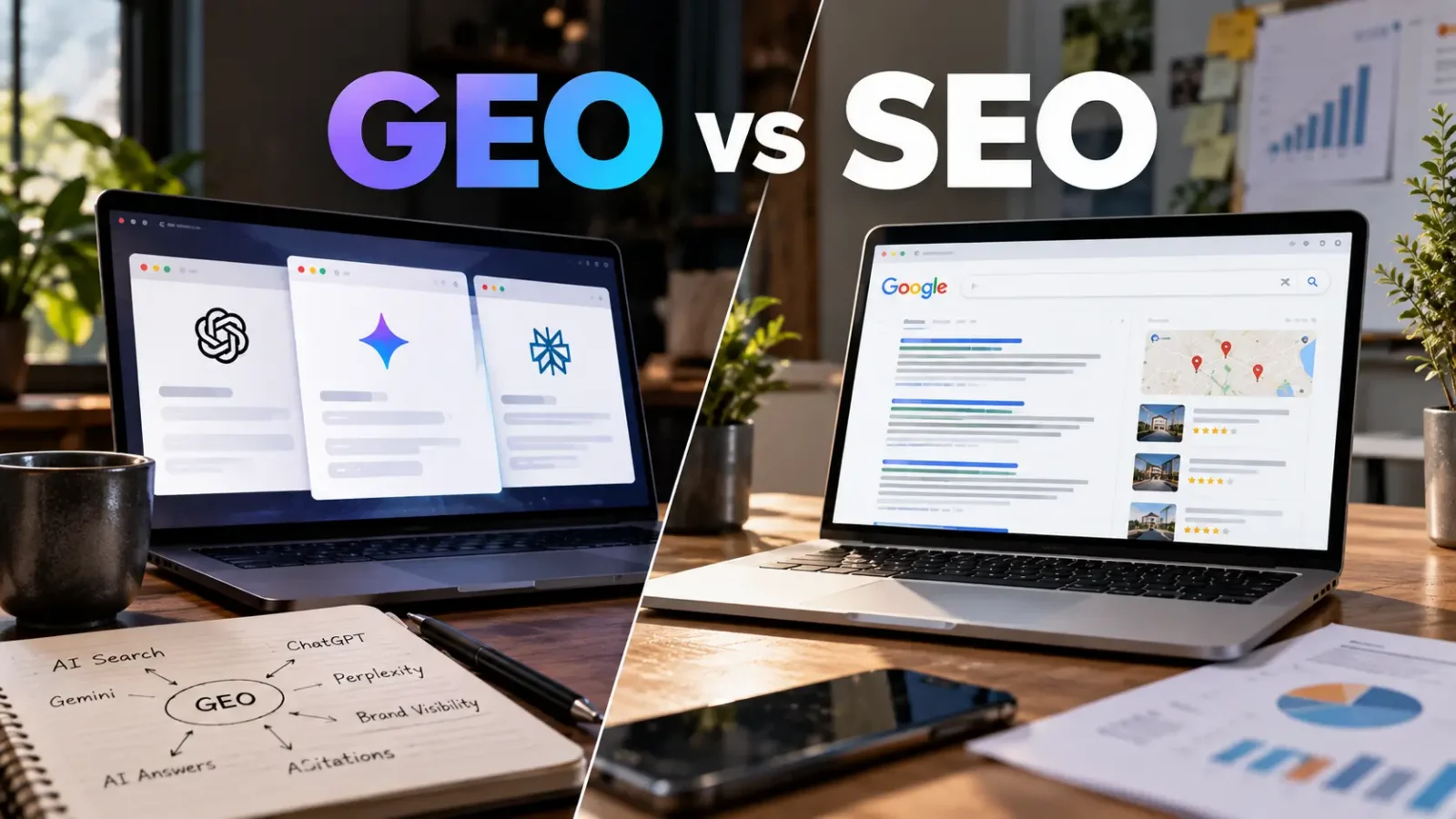
SEO aims to rank your pages in search results so people click through to your site. GEO (Generative Engine Optimization) aims to get your business mentioned and recommended inside AI-generated answers from tools like ChatGPT, Gemini and Perplexity. They share the same foundations (quality content, technical health and authority), so most businesses need both, with SEO as the base and GEO as the extension.
If you already invest in SEO, you may be wondering whether GEO is a new discipline, a rebrand or a replacement. This guide compares the two side by side, shows where they overlap, explains what changes when people search through AI, and helps you decide what your business actually needs.
What is SEO?
Search Engine Optimization is the practice of improving your website so it ranks higher in search engines like Google and Bing. It covers technical health, on-page content, links and mentions from other sites, and, for local businesses, listings such as Google Business Profile. The goal is visibility in a ranked list of results, and ultimately clicks, leads and sales.
What is GEO?
Generative Engine Optimization is the practice of improving how often and how accurately AI tools mention, cite and recommend your business in the answers they generate. Instead of a ranked list, the user gets a written answer that names a handful of options. GEO is about being one of them. For a full definition, read our guide: What Is Generative Engine Optimization (GEO)?
GEO vs SEO: the key differences
AEO (Answer Engine Optimization) often comes up in the same conversation, so it is included here. The terms overlap and practitioners use them slightly differently, so treat this table as a working guide, not a rulebook.
| SEO | AEO | GEO | |
| Main goal | Rank in search results and earn clicks | Become the direct answer to a specific question | Be mentioned and recommended in AI-generated answers |
| Where it shows up | Search result pages | Featured snippets, voice answers, answer boxes | ChatGPT, Gemini, Perplexity, AI Overviews and similar tools |
| What the user sees | A list of links | A short direct answer | A written answer that may name several businesses |
| Typical success signals | Rankings, organic traffic, leads | Snippet and answer-box presence | Brand mentions, recommendations, citations |
| Content approach | Pages targeting keywords and topics | Concise, direct answers to questions | Complete, trustworthy, answer-ready content plus a clear business identity |
| Authority signals | Links, reviews, brand searches | Page clarity and structure | Mentions across credible third-party sources, consistent entity information |
| Measurement | Rank trackers, analytics, search console | Snippet tracking | Repeated testing of a fixed set of prompts over time |
Four of these differences matter most in practice:
- The unit of success changes. SEO measures where a page ranks. GEO measures whether your business appears in an answer at all. There is rarely a “page two” in an AI response.
- The click is less guaranteed. In an AI answer, a person can learn your name and never visit your site. Visibility and traffic are no longer the same thing.
- Your business matters as much as your pages. SEO is largely about pages. GEO also depends on how consistently your business, founders and services are described across the web, because AI tools work with entities and references, not just keywords.
- Measurement is harder. AI answers can vary from one run to the next and between platforms, so GEO tracking relies on repeated tests, not a single rank number.
Where SEO and GEO overlap
Despite those differences, much of the work is shared:
- Helpful, accurate content that fully answers real questions
- Technical accessibility: crawlable pages, clean structure, fast loading, sensible structured data
- Authority: reviews, credible mentions and links from other reputable sites
- Clear business information kept consistent across your website, Google Business Profile and directories
- Ongoing updates, because outdated pages hurt both
This overlap is why GEO is better understood as an extension of SEO than a separate world. A business with weak SEO fundamentals usually has weak GEO foundations too.
What changes when people search through AI
- Queries get more conversational. People ask full questions and follow-ups instead of typing short keywords.
- Answers are assembled, not just listed. The tool decides which sources and businesses to include.
- Recommendations replace comparison shopping. A user may get a shortlist before visiting any site.
- Trust signals carry more weight. Whether credible sources mention you can matter more than how many keywords a page contains. How much any given tool relies on this varies and changes, so check current documentation before making strong claims.
- Results are less stable. The same question can return different businesses on different days or platforms.
Common misconceptions about GEO vs SEO
“GEO makes SEO obsolete.” Search engines are still widely used, and the foundations of SEO feed GEO. Treat AI search as an additional channel, not a replacement.
“GEO is just SEO with a new name.” The overlap is large, but the goal, the signals and the measurement differ. A page can rank well and still never be mentioned in an AI answer, and the reverse can also happen.
“You can pay or trick your way into AI answers.” Anyone promising guaranteed mentions is overstating what is possible. Shortcuts are risky, and what AI tools show can change without notice.
“If I rank number one, I’m covered.” Ranking helps, but it does not guarantee a mention. That is why the test above is worth running on your own market.
“AI search will replace Google soon.” Nobody can say for certain how fast behavior will shift. A sensible approach is to prepare for both without betting everything on one.
Does ranking on Google mean AI will mention you?
Not necessarily, and this is the question most businesses should test before spending anything.
We ran What is the best CRM for a small business? buyer-style questions through Google, ChatGPT, Gemini and Perplexity and compared who ranked at the top of Google with who each AI tool named.
Date tested: 06th Oct 2026
| Question | Top Google results | Named by ChatGPT | Named by Gemini | Named by Perplexity | Overlap with Google? |
|---|---|---|---|---|---|
| What is the best CRM for a small business? | HubSpot, Zoho CRM, Pipedrive, monday CRM, Freshsales, Salesforce | HubSpot, Zoho CRM, Pipedrive, Freshsales, monday CRM | HubSpot, Zoho CRM/Bigin, Pipedrive, monday CRM, Salesforce | HubSpot, Bigin, Zoho CRM, monday.com, HoneyBook, Less Annoying CRM, Salesforce | Yes — strong overlap |
What we noticed: HubSpot showed the strongest cross-platform consistency, appearing in Google results as well as all three AI answers. Zoho, Pipedrive and monday CRM also appeared repeatedly, but the AI platforms introduced different recommendations depending on the use case. Perplexity produced the broadest set of alternatives, while Gemini and ChatGPT stayed closer to the commonly cited SMB CRM shortlist.
This is a small test on one date, not a study. AI answers vary, so results may differ when you repeat it.
Is your SEO ready for GEO? A quick checklist
If you can answer yes to most of these, your foundations are in reasonable shape:
- Does your website clearly state who you are, what you do, who you serve and where?
- Do your key pages answer customer questions directly near the top?
- Is your business described consistently on your site, Google Business Profile, LinkedIn and directories?
- Do credible third-party sites mention or review your business?
- Can search engines crawl your pages, and do they load quickly?
- Do you know how AI tools currently describe your business?
The last question is the one most businesses cannot yet answer, and it is the best place to start.
Do businesses need both? SEO & GEO
For most businesses that rely on online research to win customers, yes. A practical way to decide:
| Your situation | What to prioritize |
| Weak website, little organic traffic, few reviews or mentions | SEO foundations first. GEO builds on them. |
| Good SEO, but you are missing from AI answers competitors appear in | Add GEO: entity consistency, answer-ready content, third-party mentions |
| Local or service business customers search with “near me” style questions | Local SEO and Google Business Profile first, then GEO |
| B2B or professional services where buyers shortlist vendors before contacting anyone | Both; AI shortlists are likely part of your buyer’s research |
| Customers rarely research online | Neither is the top priority; focus on channels where your buyers are |
The “right” balance depends on your market, your competitors and where your buyers actually look. Test before assuming.
Not sure which one your business needs first? TechSpeak combines SEO and Generative Engine Optimization so you do not have to choose. Book a 30-minute strategy call and we will look at where you stand.
How TechSpeak approaches SEO and GEO together
We treat GEO as an extension of SEO, not a replacement. In practice that means working in this order:
- Check the foundations. Technical health, content quality and local listings come first, because both disciplines depend on them.
- Make the business easy to identify. Consistent descriptions of who you are, what you do and who you serve across your site and key profiles.
- Build answer-ready content. Pages that answer real customer questions directly, backed by evidence.
- Earn credible mentions. Third-party references that show your business is established.
- Measure both. Rankings and traffic for SEO, plus repeated prompt testing for AI visibility.
We do not promise specific rankings or AI mentions, because no one controls what search engines or AI tools show.
Frequently asked questions
Is GEO replacing SEO? No. GEO builds on SEO. Strong content, technical health and authority help both. AI tools are an additional place people look, not a replacement for search engines.
Is GEO part of SEO? It is best seen as an extension. Many practices overlap, but GEO adds a focus on brand mentions, entity clarity and being recommended inside AI-generated answers.
Which is more important: SEO or GEO? For most businesses, SEO is the foundation and should come first, with GEO added on top. The right balance depends on where your customers actually search.
Does SEO help with ChatGPT visibility? Often indirectly. Good content, technical health and authority help both. But ranking well on Google does not guarantee an AI tool will mention you, which is why testing matters.
How is GEO measured? Differently from SEO. Instead of a ranking position, you track whether your brand is mentioned, recommended or cited across a fixed set of prompts, repeated over time and across platforms.
Should a small business invest in GEO? It depends on whether your customers research online and might ask AI tools for recommendations. Fix your basics first (website clarity, reviews and local listings, covered by local SEO), then test how AI tools describe you before deciding how much to invest.
Want to know where you stand?
Start with our guide: What Is Generative Engine Optimization (GEO)? Then, when you are ready to look at your own business:
Book a 30-minute strategy call with TechSpeak or contact us to discuss SEO and GEO for your business.

Techspeak Team
Part of the Techspeak team, writing about SEO, GEO, local search and growth.