How to Get Your Business Mentioned by ChatGPT, Gemini & Perplexity
 By Techspeak Team
November 2, 2026
13 min read
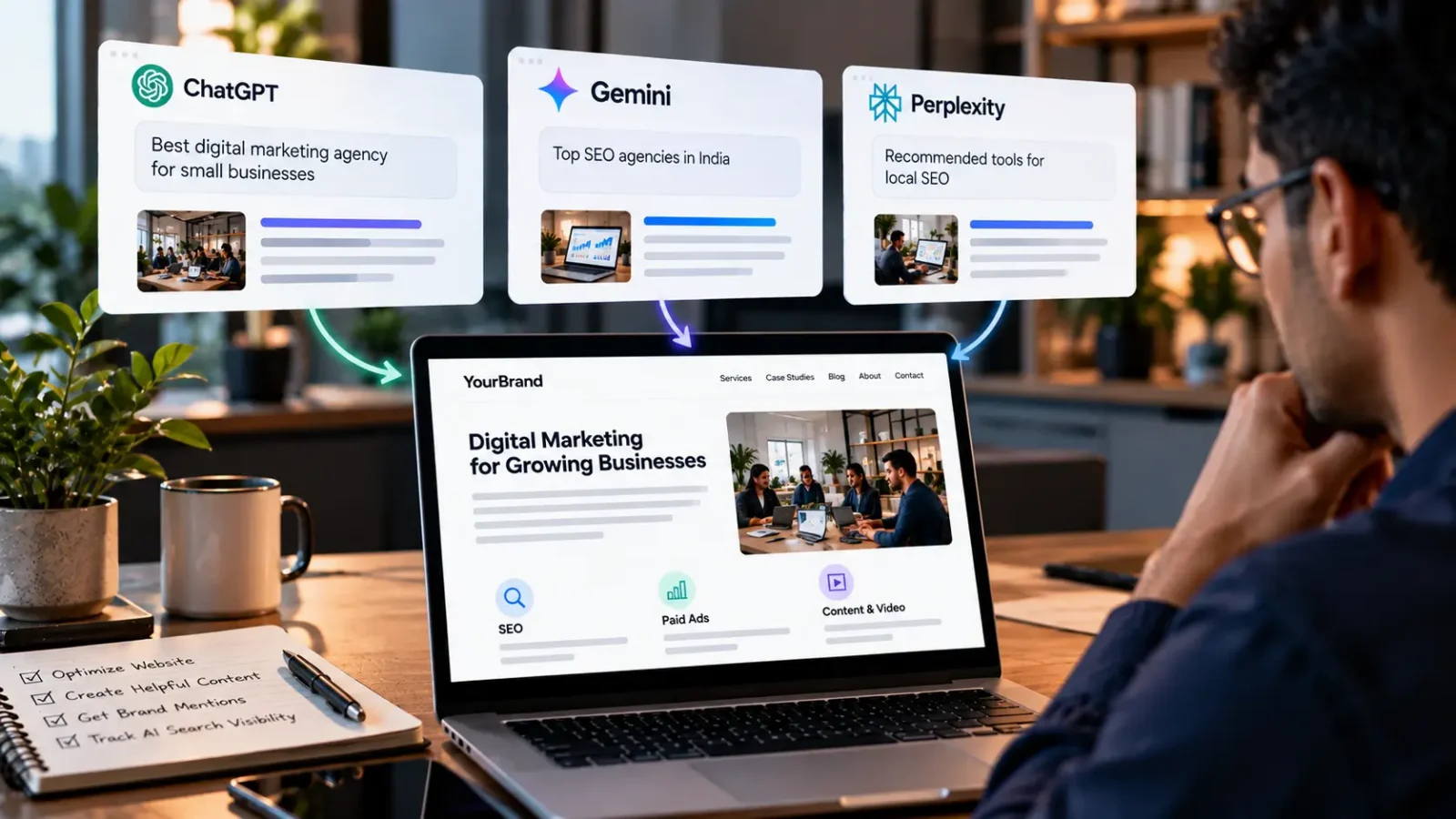
You cannot directly control what ChatGPT, Gemini or Perplexity say, but you can improve your chances of being mentioned. Start by measuring where you appear today across all three. Then make your business easy to identify, publish content that answers real buyer questions, earn credible mentions from third-party sources, and re-test on a schedule. The work is gradual and results are never guaranteed, but it is practical and measurable.
Most businesses ask this question after discovering that a competitor is being recommended by an AI assistant and they are not. The temptation is to look for a shortcut. There is no reliable one. What works is making your business clearer, more consistent and more credible in the places AI tools read, and then checking whether it is making a difference.
This guide gives you a platform-aware roadmap: what you can and cannot control, why the three platforms can give different answers, how to build a baseline, what to fix, what to publish, how to earn mentions and how to run a 90-day plan.
Can you directly control AI recommendations?
No, and anyone who says otherwise is overstating what is possible.
- You cannot pay for a guaranteed mention in the organic answers of these tools. Check each platform’s current policies, as products change.
- You cannot submit a form to be included. These tools do not work like a directory.
- You cannot lock in a result. Answers vary between runs, across platforms and over time.
What you can do is influence the inputs: how clearly your business is described, how consistent your information is, how useful your content is and how often credible sources reference you. That is the practice of Generative Engine Optimization (GEO).
If your business is not appearing at all, start with the diagnosis in Why Is My Business Not Showing Up in ChatGPT? and come back here for the roadmap.
Why AI platforms can recommend different businesses
Ask the same question on ChatGPT, Gemini and Perplexity and you may get different businesses named. Common reasons include:
- Different information sources. Each tool draws on different training data and, in some modes, different live web sources.
- Different retrieval and citation behavior. Some tools lean heavily on current web results and show sources, while others rely more on what they learned in training. This changes over time.
- Personalization and context. Location, account settings, conversation history and mode can affect answers.
- Model updates. Platforms change models and features often, so results shift.
- Even with the same prompt, answers can vary.
The practical lesson: do not optimize for one assistant or judge by one result. Aim for a business that is easy to understand and verify wherever the information is found, then test across all three.
Start with a cross-platform visibility baseline
Before changing anything, find out where you stand.
- Write a fixed set of buyer-style prompts. Include category (“best [service] for [audience]”), comparison, problem and brand prompts, plus location if relevant.
- Run them on ChatGPT, Gemini and Perplexity, more than once each, and record the date.
- Note who is mentioned and recommended, whether you appear, how you are described, and which sources are cited.
- Record the gaps. Where are competitors named and you are not? Where are you described inaccurately?
For formulas, a prompt-set method and a report structure, see How to Measure Your Brand’s Visibility in AI Search. For a page-level view of how AI engines may read your content, you can also run key pages through an AI-visibility audit tool.
Build a strong business entity and information footprint
AI tools work with entities: clearly identifiable businesses, people and services. The easier you are to identify and verify, the easier you are to describe.
- State the basics plainly on your website: who you are, what you offer, who you serve and where. Put this on your homepage, about page and main service pages.
- Keep details identical everywhere: name, description, address, phone, services and links across your website, Google Business Profile, LinkedIn and key directories.
- Complete your profiles on the platforms your customers use, and remove or correct outdated listings.
- Use structured data where appropriate, such as organization, local business, service and FAQ markup, so machines can read what a page is about. It helps clarity but does not guarantee mentions.
- Show real people and expertise: author pages, team pages and credentials make your business easier to trust and verify.
Create content AI systems can understand and trust
AI tools favor content that is clear, complete and credible. In practice:
- Answer the question first. Put a direct answer near the top, then explain.
- Use descriptive headings that match how people ask the question.
- Cover topics completely, including comparisons, costs, limitations and next steps.
- Add evidence: examples, case studies, original data, screenshots and first-hand experience.
- Keep content current, and show updated dates on pages that change.
- Add an FAQ that answers real customer questions in plain language.
- Make claims you can support. Vague superlatives (“the best agency”) add little.
Good SEO writing and good GEO writing overlap heavily. See GEO vs SEO for how they relate.
Strengthen authority and third-party references
AI tools tend to favor businesses that credible sources mention. Your own website saying you are good is rarely enough on its own. Ways to earn references legitimately:
- Customer reviews on the platforms your buyers use
- Industry publications and guest articles where you share real expertise
- Podcasts, webinars and interviews
- Partner, supplier and association pages that list your business
- Directories and industry lists relevant to your category
- Case studies and customer stories, with permission
- Digital PR and reputation work that earns genuine coverage. TechSpeak’s content and reputation services cover this area.
Quality matters more than volume. A few credible mentions are worth more than many low-quality ones.
Optimize for answer-oriented queries
People ask AI tools full questions, not short keywords. Map the questions your buyers ask and make sure each has a clear answer on your site.
| Question type | Example | What to publish |
| Category | “Best [service] for [audience]” | A clear service page and a guide for that audience |
| Comparison | “[Option A] vs [Option B]” | A fair, evidence-based comparison page |
| Problem | “How do I fix [problem]?” | A practical how-to that leads to your service |
| Cost | “How much does [service] cost?” | A transparent pricing-factors guide |
| Brand | “What is [your company]?” | A clear about page and consistent profiles |
| Local | “Best [service] in [city]” | Location pages and an up-to-date Google Business Profile |
Quick wins you can do this week
You do not need a large program to begin. These steps are low effort and useful whatever else you decide:
- Run your baseline with ten buyer-style prompts on all three platforms and save the answers.
- Rewrite your homepage opening so it states who you are, what you do, who you serve and where in two or three plain sentences.
- Audit your business details across your website, Google Business Profile, LinkedIn and your top directories, and fix any mismatch.
- Pick your three most important buyer questions and check that each has a clear, direct answer on your site.
- Ask recent happy customers for a review on the platform your buyers trust most.
- Check that your key pages can be crawled and read, and that any blocking of AI crawlers is intentional.
- Update your oldest important pages with current information and a visible updated date.
If you are a local or service business
Local businesses often have the clearest quick wins, because AI tools can answer “best [service] near me” style questions with specific local names.
- Keep your Google Business Profile complete and current: services, hours, categories, photos and description.
- Collect reviews steadily and respond to them. Review volume, recency and content may all give signals about your business.
- Create clear location and service pages that name the areas you serve and the services you offer.
- Keep your name, address and phone number identical on every listing and directory.
- Earn local mentions: chambers of commerce, local press, community partners and industry associations.
TechSpeak’s local SEO services cover profile management and local visibility.
Platform notes: ChatGPT, Gemini and Perplexity
These are general observations that change often. Verify current behavior in each platform’s own documentation before relying on them.
| ChatGPT | Gemini | Perplexity | |
| What it is | OpenAI’s AI assistant | Google’s AI assistant | An AI answer engine built around web search |
| How it may find information | Training data and, in some modes, live web search | Google’s ecosystem and models; may use Google search results | Typically searches the web and shows cited sources |
| What this suggests for you | Clear, consistent public information about your business matters | Strong SEO, Google Business Profile and website clarity may help | Being citable, with clear and current pages, matters |
| How to track it | Repeated prompt testing | Repeated prompt testing | Repeated prompt testing plus source review |
Whatever the platform, the foundations are the same: clear information, useful content, credible mentions and consistent measurement.
Measure mentions and recommendation patterns over time
Re-run your prompt set on a regular schedule, such as monthly, and track:
- Mention rate and recommendation rate across platforms
- Share of voice compared with competitors
- Accuracy of how you are described
- Sources cited, where the platform shows them
- Referral visits and brand searches, as supporting signals
Treat changes as trends, not single results, because answers vary.
A practical 90-day GEO roadmap
This is a planning framework, not a promise of results. Timelines vary, and some changes take longer than 90 days to show.
| Period | Focus | Key actions |
| Weeks 1–2 | Baseline and diagnosis | Build the prompt set, run it across the three platforms, record gaps, list the issues to fix |
| Weeks 3–4 | Foundations | Clarify website messaging, standardize business details everywhere, fix technical and profile issues |
| Weeks 5–8 | Content | Publish pages that answer your top buyer questions, add FAQs and evidence, update old content |
| Weeks 9–12 | Authority and re-test | Pursue reviews and third-party mentions, re-run the prompt set, compare against baseline, plan the next cycle |
What to avoid
- Fake reviews or fake mentions. They are unethical, may break platform rules and can damage trust.
- Mass-producing thin AI content. Volume without usefulness rarely helps.
- Hidden text or tricks aimed at AI tools. These can backfire and are not worth the risk.
- Keyword stuffing. It hurts readability for people and machines.
- Buying low-quality links or mentions. Credible sources matter more than counts.
- Promising or expecting guarantees. No one controls what AI tools show.
Sample cross-platform workflow
Business (anonymized): Brand A — HubSpot (CRM software)
Date of baseline: October 13, 2026
Prompts tested: 1 unique prompt
Platforms: ChatGPT, Gemini, Perplexity
| Prompt | ChatGPT | Gemini | Perplexity | Gap we spotted | Action taken |
|---|---|---|---|---|---|
| What is the best CRM for a small business? | Named HubSpot as best overall/easiest to use | Named HubSpot best overall for ease of use and marketing | Named HubSpot best all-rounder | No mention gap for HubSpot. Each platform surfaced different alternatives and use cases. | Record HubSpot’s consistent visibility; review its positioning, product information and supporting third-party coverage. |
| What is the best CRM for a small business with a limited budget? | Not tested | Not tested | Not tested | Pending — no comparable results available | Run the exact prompt on all three platforms and record brand mentions and citations. |
| What is the best CRM for a small business that needs sales automation? | Not tested | Not tested | Not tested | Pending — no comparable results available | Run the exact prompt on all three platforms and compare recommendations, cited sources and missing brands. |
What we noticed
-
HubSpot appeared consistently across all three platforms for the general buyer query. All three positioned it as their leading overall recommendation.
-
The alternatives differed: ChatGPT included Freshsales, Gemini highlighted Salesforce Starter Suite for scaling, and Perplexity included HoneyBook and Less Annoying CRM. This suggests differences in recommendation breadth and use-case framing.
-
We cannot yet measure variation between repeated runs. Each platform was tested once for this prompt, and the other two prompts remain untested. The current findings establish a baseline, not proof of a persistent ranking pattern.
Optional: before-and-after re-test
No re-test has been conducted yet, so there is no verified improvement to report. After making content or digital PR changes, rerun the same prompts across all three platforms and compare:
-
Brand mention and recommendation rates
-
Citation sources and citation frequency
-
New or missing competitors
-
Changes across repeated runs
Methodology note: This is a single-prompt pilot based on the responses supplied in this conversation, not a full client case study. The proposed actions are recommendations; they have not yet been implemented or verified.
When to do it yourself and when to get help
You can start on your own with the baseline, the foundations and the content steps above. Help makes sense when:
- You are not sure which gaps matter most
- You lack time to test and track consistently
- Your business details are inconsistent across many listings
- Competitors clearly dominate your category’s answers
- You want a measured plan and reporting
Want a platform-aware plan for your business? TechSpeak’s Generative Engine Optimization services combine SEO foundations with AI-search work. Book a 30-minute strategy call and we will look at where you stand across ChatGPT, Gemini and Perplexity.
Frequently asked questions
Can I pay to appear in ChatGPT recommendations? There is no known way to pay for a guaranteed mention in the organic answers of these tools. Products and policies change, so check each platform’s current guidance. Be cautious of anyone selling guaranteed placement.
How does ChatGPT find information about businesses? It can draw on what it learned during training and, in some versions and modes, on live web search. Which it uses varies by product and question, so check current documentation.
Does Google ranking affect AI search visibility? It can help indirectly, because strong content, technical health and authority support both. It does not guarantee an AI mention. See GEO vs SEO.
Why do ChatGPT and Gemini give different recommendations? They differ in data sources, retrieval, personalization and model updates, and answers also vary run to run. That is why testing across platforms matters.
Should I optimize separately for each platform? Mostly no. The foundations are shared: clear information, helpful content and credible mentions. Test on each platform and adjust where your results differ.
Do backlinks and social media matter for AI visibility? Credible mentions and links from reputable sources can support your authority. Social profiles help your business be identifiable and consistent. Neither is a guaranteed lever.
How long does GEO take to show results? There is no fixed timeline. Foundation fixes can be done quickly, while authority and mentions typically build over months. Track trends over repeated tests.
What should I measure? Mention rate, recommendation rate, share of voice, accuracy and, where available, citations and referral visits. See how to measure your brand’s visibility in AI search.
Ready to improve your AI visibility?
Start with the basics in What Is Generative Engine Optimization (GEO)?, then diagnose your gaps with Why Is My Business Not Showing Up in ChatGPT?
Book a 30-minute strategy call with TechSpeak or contact us to discuss a GEO strategy for your business.

Techspeak Team
Part of the Techspeak team, writing about SEO, GEO, local search and growth.