What Is AEO? Answer Engine Optimization Explained
 By Techspeak Team
November 10, 2026
10 min read
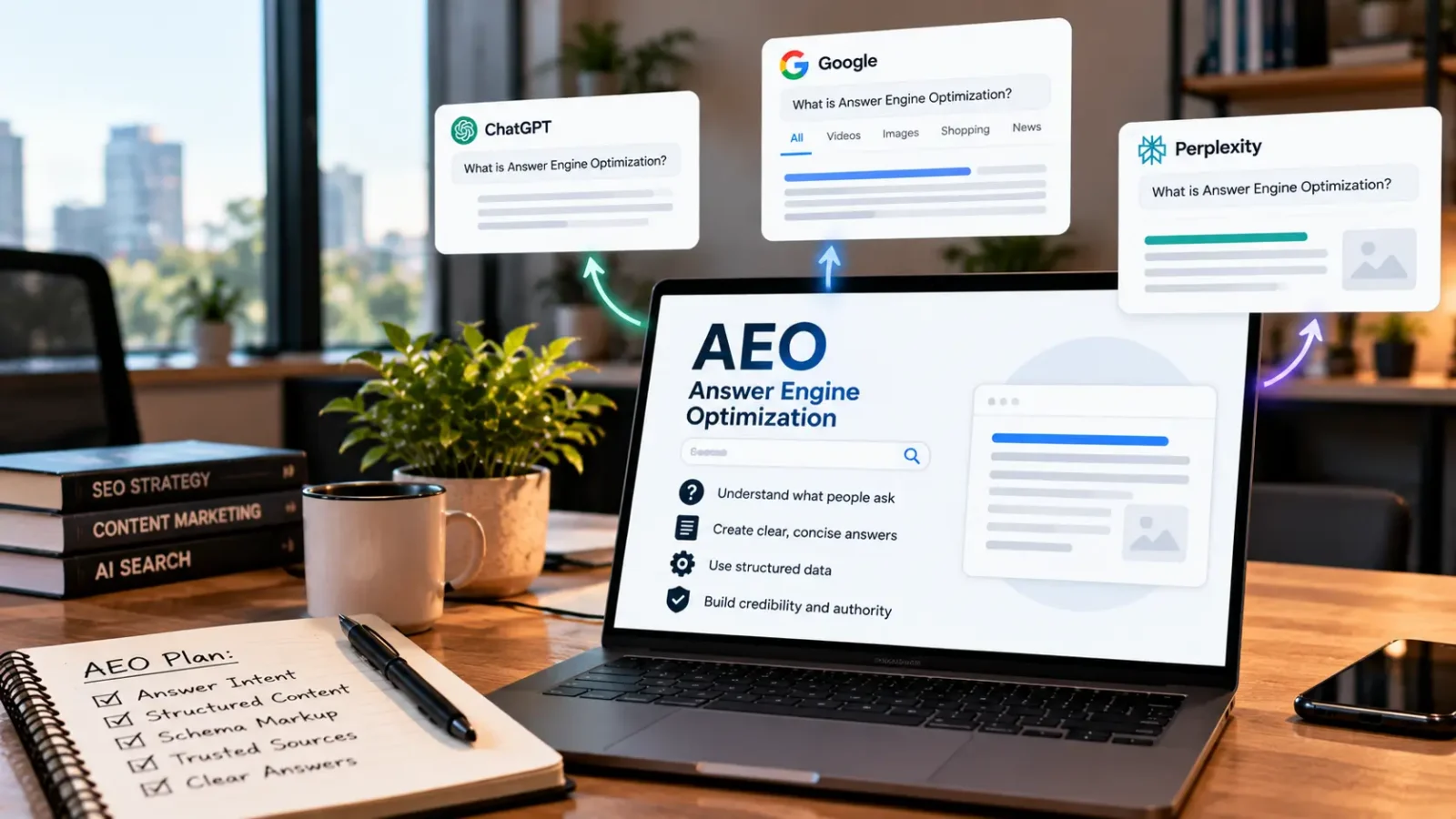
AEO (Answer Engine Optimization) is the practice of structuring your content so search engines, voice assistants and AI tools can find it, understand it and present it as the direct answer to a question. It focuses on clear questions, concise answers and well-organized pages, and it builds on the same foundations as SEO.
More and more searches end with an answer on the results page, a spoken reply from a voice assistant or a written response from an AI tool, instead of a click on a blue link. If your content is the source of that answer, your business gets seen. If it is not, a competitor’s content does the job.
This guide explains what AEO is, what counts as an “answer engine”, how AEO works in practice, a step-by-step way to start, what it can and cannot do, and how it relates to SEO and GEO.
What does AEO stand for?
AEO stands for Answer Engine Optimization. The term can be confused with other uses of the same letters, so you will often see it written out in full. In this guide, AEO always means optimizing content for answer engines.
One point is worth knowing: practitioners use the term in two ways.
- A narrower meaning: optimizing for answer features in search results, such as featured snippets, “People Also Ask” boxes, knowledge panels and voice assistant replies.
- A broader meaning: optimizing for any system that produces an answer, including AI assistants like ChatGPT, Gemini and Perplexity.
There is no single official definition. The practical steps overlap heavily either way, so this guide covers both.
What is an answer engine?
An answer engine is any system that responds to a question with an answer instead of only a list of links. Common examples include:
- Search engines with answer features: featured snippets, “People Also Ask”, knowledge panels and AI-generated summaries on the results page
- Voice assistants: which read out a single answer
- AI assistants and AI search tools: which write a response and may cite or name sources
What these have in common is that the user often gets the answer without visiting a website first. That shifts the goal from “rank so people click” to “be the source the answer is built from”.
Why AEO matters for businesses
- People ask questions. Most buying journeys start with questions: what is it, how does it work, how much does it cost, which option is better.
- Answers shape shortlists. If a tool names or cites your business in an answer, you are in the running before anyone visits your site.
- Clear content helps everyone. Pages written to answer questions clearly also tend to serve human readers better.
One honest caution: for simple factual questions, an answer shown directly on the results page can mean fewer clicks. AEO tends to be most valuable for questions where people need more than the quick answer, such as comparisons, decisions and services, because those readers still want to go deeper.
How AEO works: the core principles
AEO is not a trick. It is a set of writing and structure habits that make your content easy to extract and trust.
- Start from the real question. Each page or section should answer a specific question people actually ask, in the way they ask it.
- Give the answer first. Put a short, direct answer right under the question, then add detail. A common guideline is a couple of sentences, or roughly the length of a short paragraph. It is a rule of thumb, not a requirement.
- Use clear structure. Question-style headings, short paragraphs, lists for steps and options, and tables for comparisons make it easy for systems to pull out the right piece.
- Cover the topic and its follow-ups. People rarely stop at one question. A page that also answers the obvious next questions is more useful and more likely to be used.
- Show credibility. Name the author, show dates, cite your sources and include examples or evidence. Answers built from trustworthy content are more likely to be used.
- Make the page machine-readable. Clean HTML, sensible headings and, where appropriate, structured data (schema markup) help systems understand what a page is about. Search engines change which structured data features they show over time, so check Google’s current documentation before relying on any specific markup.
- Keep it current. Outdated answers lose value. Review important pages regularly and show when they were last updated.
What an AEO-friendly answer looks like
Here is an illustrative before and after for a made-up page.
Before (typical): “Welcome to our guide. Many businesses wonder about this topic, and in today’s competitive landscape it is more important than ever. In this article we will explore many factors that may influence the answer…” The real answer appears several paragraphs down.
After (answer-first):
How long does a website redesign take? A typical website redesign takes several weeks to a few months, depending on the number of pages, the amount of new content and how many review rounds are needed. Smaller sites can move faster, and larger or more complex sites take longer. The main factors are:
- Number of pages and templates
- Who writes the content, and how quickly
- Design and review rounds
- Technical requirements and integrations
The second version states the answer immediately, names the factors in a scannable list and invites the reader to continue. That is the pattern to aim for.
Before and after: applying answer-first writing to a new article
Illustrative example: How we structure content to make answers clearer and easier to navigate.
Rather than comparing an old page with a rewritten version, this example demonstrates how we can improve a section while creating new content for TechSpeak.
Example question: What is Generative Engine Optimization (GEO)?
Before: a generic introduction
Generative Engine Optimization is an emerging approach to digital marketing that focuses on optimizing content for AI-powered search engines and generative platforms. As artificial intelligence continues to evolve, businesses need to understand new ways to improve their online visibility.
After: a direct, answer-first introduction
Generative Engine Optimization (GEO) is the practice of improving a brand’s visibility in AI-generated answers across platforms such as ChatGPT, Google AI Overviews and Perplexity. It involves creating useful, accurate and well-structured content that helps AI systems understand a brand and its expertise. However, inclusion in AI-generated answers is not guaranteed.
What changed?
| Element | Before | After | What changed |
|---|---|---|---|
| Question or heading | Broad introduction to GEO | Direct question: “What is GEO?” | Makes the section’s purpose explicit. |
| Opening answer | General discussion of the industry | Defines GEO in the first sentence | Gives readers the core answer immediately. |
| Structure | Broad introductory paragraph | Definition followed by explanation and qualification | Makes the information easier to scan and understand. |
| Evidence and credibility | General statements about AI | Names relevant platforms and clarifies that visibility is not guaranteed | Makes the explanation more concrete without claiming unverified results. |
What we noticed
- The revised version answers the question immediately instead of making readers work through a broad introduction.
- The explanation uses concrete examples and avoids implying that any optimization technique guarantees AI citations.
- This is a writing comparison, not a performance case study. We have not measured ranking changes, featured snippets or AI search visibility attributable to this example.
Note: This is an illustrative example created for demonstration. It is not a historical rewrite of a published article, and no performance improvement is claimed.
AEO, SEO and GEO: how they relate
The three terms overlap, and the lines between them are blurry:
- SEO is about ranking pages in search results.
- AEO is about being the answer to a specific question.
- GEO is about being mentioned and recommended in AI-generated answers.
They share the same foundations: helpful content, technical health and credibility. A business with strong SEO fundamentals is usually well placed for AEO and GEO. For the full side-by-side comparison, read GEO vs SEO: What’s the Difference and Do You Need Both? and for the definition of the AI-focused side, see What Is Generative Engine Optimization (GEO)?
What AEO can and cannot do
What AEO can do:
- Make your content clearer and more useful for readers and machines
- Improve your chances of being used as the source for an answer
- Help you reach people at the question-asking stage of their journey
- Strengthen your SEO at the same time
What AEO cannot do:
- Guarantee a featured snippet or an AI mention. Search engines and AI tools decide what to show, and it can change.
- Replace good content. A well-structured page with weak substance will not perform.
- Deliver instant results. Rewrites and authority take time to be noticed.
- Work in isolation. It depends on solid SEO, accurate business information and credible mentions elsewhere.
Who should care about AEO first?
AEO suits any business that publishes content answering customer questions, especially:
- Service businesses and agencies, where buyers ask “how does it work” and “how much does it cost”
- B2B and SaaS companies, where buyers research before contacting anyone
- Local businesses, where voice and “near me” style questions are common
- Health, finance and education brands, where accuracy and trust are critical
How to start with AEO: five steps
Step 1: List your top questions. Collect ten questions your customers ask, from sales calls, support emails, search suggestions and “People Also Ask” boxes.
Step 2: Check what answers appear today. Search each question and note who is shown, in what format, and what the answer looks like. Test a few on AI assistants too.
Step 3: Rewrite one important page answer-first. Add a question-style heading, a direct answer, a short list or table and a clear next step.
Step 4: Add an FAQ section to key pages, using real questions and plain answers.
Step 5: Re-check on a schedule. Look again in a few weeks and record what changed. Answers vary, so track trends instead of single results. For AI answers, see how to measure your brand’s visibility in AI search. For a page-level view of how AI engines may read your content, you can also try an AI-visibility audit tool.
Want help turning your content into answers? TechSpeak’s Generative Engine Optimization services build on SEO foundations. Book a 30-minute strategy call and we will look at where your content stands.
Frequently asked questions
What does AEO stand for? Answer Engine Optimization: optimizing content so search engines, voice assistants and AI tools can use it as the direct answer to a question.
Is AEO the same as SEO? No, but they overlap. SEO is about ranking pages, while AEO is about being the answer to a specific question. Good SEO supports AEO.
Is AEO the same as GEO? They are closely related and sometimes used interchangeably. AEO usually emphasizes answer features and direct answers, while GEO emphasizes being mentioned and recommended in AI-generated answers. See What Is GEO?
Does AEO help with voice search? Answer-first, conversational content is the same kind of content voice assistants tend to read out. There is no guarantee, because each assistant chooses its own sources.
Do featured snippets still matter? They are still one way answers are shown, alongside newer AI answer formats. What counts is being clear and credible so your content can be used wherever answers appear.
Do I need structured data for AEO? It can help machines understand your pages, but it is not a requirement and does not guarantee anything. Check current guidelines from the search engines you care about before investing in specific markup.
How long does AEO take to work? There is no fixed timeline. Rewriting a page is quick, but being picked up as a source depends on authority, competition and how often systems refresh. Track changes over time.
Ready to get started?
Start with the five steps above. When you are ready to go deeper, read Why My Website not showing up in Chatgpt and the GEO Vs SEO.
Book a 30-minute strategy call with TechSpeak or contact us to talk about answer-ready content for your business.

Techspeak Team
Part of the Techspeak team, writing about SEO, GEO, local search and growth.